The Real Cost of Bad Parcel Data in FTTH Design
The FCC's broadband location challenge process has corrected roughly 2.5 million availability points, with about 69% of submitted challenges upheld [FCC Broadband Data Collection, 2024]. Every one of those corrections began as a parcel that someone designed around, or should have.
That matters right now because BEAD ties both eligibility and the served-location count to the Broadband Serviceable Location Fabric, which is assembled from parcel boundaries, tax assessment records, and building footprints and is, by its own methodology, expected to contain errors [FCC Broadband Data Collection, 2025]. With underground fiber at a median of $18.25 per foot in 2024 [FBA/Cartesian, 2024], a wrong parcel is not a spreadsheet typo. It is conduit, splices, and truck rolls.
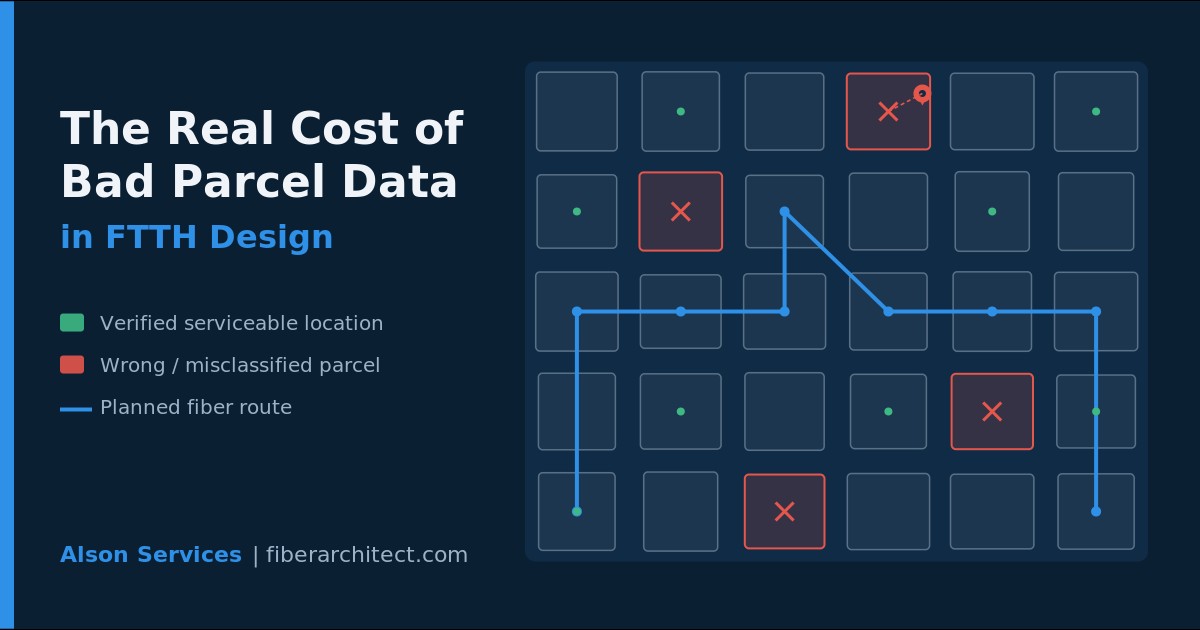
Bad parcel data inflates cost per pass from both directions. A location that does not exist still gets a designed drop, a port assignment, and footage in the route, so your material order and your denominator are both wrong. Labor runs 60 to 80 percent of deployment cost [FBA/Cartesian, 2024], which means the expensive waste is crew hours spent at a barn or an empty lot, not the glass itself. Undercounting is worse. Real homes get discovered after the build is sequenced, when adding them means remobilizing crews.
Most of these errors are predictable. Parcels geocoded to a lot centroid instead of the structure, agricultural buildings classified as residential, and multi-unit parcels counted as a single location all push splice points and slack to the wrong coordinates. The fix is not trusting one map. It is reconciling parcel polygons against building footprints, then validating the disagreements in the field before the low-level design is locked.
This is where AI agents earn their place. An agent can cross-check parcel records, assessor data, and footprints across thousands of locations, flag only the points where the three sources disagree, and queue those for a person to confirm. The engineer keeps the judgment. The agent removes the rote reconciliation that no one has time to do by hand.
Alson builds custom agents in-house to catch these parcel and location errors before they reach the design, so the served-location count behind your cost per pass is validated rather than assumed.
For anyone approving a build budget, the question to ask first is simple: what was the BSL count validated against? A cost per pass built on unverified parcel data is an estimate with an unknown error bar, and that error tends to surface as change orders halfway through construction.
As BEAD projects move from planning into the ground, the builds that reconcile parcel data first are the ones whose cost per pass will actually hold.