NEPA, Not Splicing, Sets Your BEAD Schedule
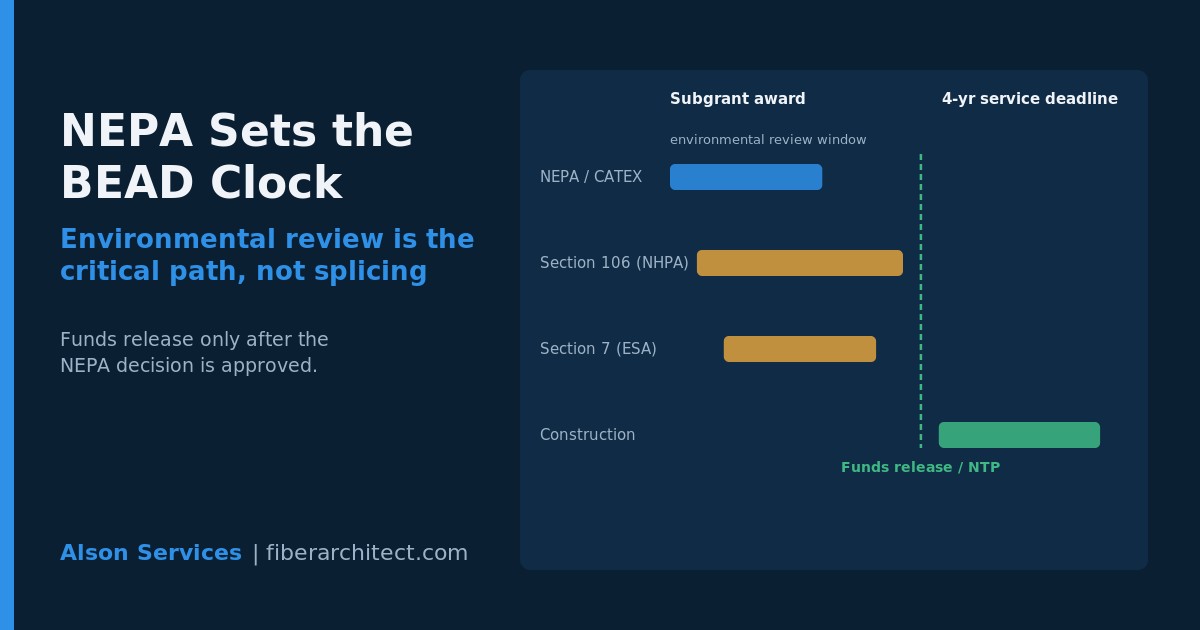
Funds will not be disbursed until NTIA approves the NEPA decision document. That one line, buried in every BEAD subgrant condition, decides when your crews actually break ground.
Construction on the first BEAD-funded projects is expected to begin as early as summer 2026, with 54 of 56 states and territories holding approved Final Proposals [NTIA, 2026]. The money is no longer the bottleneck. The clock that matters now starts at the subgrant: every subgrantee makes a binding commitment to provide service by a date certain, earlier than four years after award, backed by contractual penalties for missing it [NTIA RPN, 2025]. Environmental documentation, not splicing, is what eats that window.
BEAD runs on the National Environmental Policy Act. Every BSL you intend to build gets sorted into one of three review levels: Categorical Exclusion, Environmental Assessment, or Environmental Impact Statement [NTIA, 2024]. Most fiber routes qualify for a CATEX, but a CATEX is not a free pass. You still have to document the route, confirm no extraordinary circumstances apply, and clear it before funds release.
The harder work sits in the parallel consultations. Subgrantees must complete Section 106 review under the National Historic Preservation Act and, where habitat is in play, Section 7 consultation under the Endangered Species Act [NTIA, 2024]. These run on agency calendars, not yours. A single Section 106 finding on a creek crossing or a pole line near a historic district can add months. Only a short list of limited activities is permitted before clearance, so a route that looks clean on paper can still sit idle.
That is why the milestone schedule is now a core deliverable, not paperwork. It must identify every environmental review and permitting activity, the dependencies between them, and the deadlines, and show how you meet the statutory reviews on time [NTIA, 2024]. A schedule that ignores a known ESA window or a State Historic Preservation Office backlog is a commitment you will not keep.
This is where Alson's low-level design work lives. Permit documentation, route mapping, and the dependency sequencing behind a credible milestone schedule are built into the splice charts and cable routing we produce, so the environmental clock and the construction clock are planned together rather than discovered in sequence.
For anyone making the call right now: treat NEPA and Section 106 timelines as the critical path, not an administrative step after design. Pull the SHPO and wildlife review windows for your service area before you commit to a service date, because the four-year clock does not pause while a finding is pending.
The states that finish first will be the ones that engineered the documentation alongside the network.