Permitting Is the BEAD Bottleneck You Can Control
Permitting now runs about 10 percent of an average fiber project's cost, and its larger effect lands on the calendar. Nearly two-thirds of deployers expect longer deployment timelines in 2026 [FBA and Cartesian, 2025]. On a BEAD build, the permit office, not the crew, sets your start date.
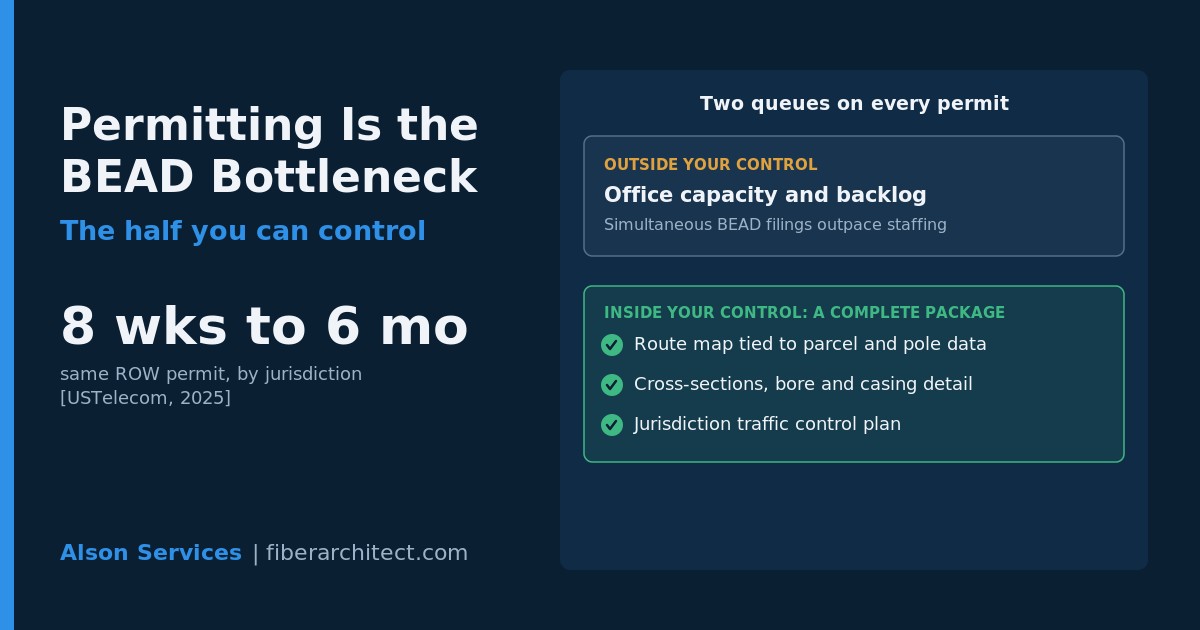
As construction ramps across dozens of states at once, local and state permitting offices are absorbing an unprecedented volume of simultaneous applications that has outpaced their capacity [USTelecom, 2025]. The same type of right-of-way permit can clear in eight weeks in one jurisdiction and take six months in the next [USTelecom, 2025]. That variance, not the soil or the pole line, is what moves an in-service date.
Two federal programs are pushing applications through the same municipal offices, county DOTs, and state agencies at the same time, and staffing did not scale with the funding. Some state broadband officers are turning resubmissions in under 12 hours to keep pace [Broadband Breakfast, 2025]. Part of the queue is simply outside a builder's control.
The part inside your control is application quality. Most delays past the queue come from incomplete packages: missing forms, an unclear route map, incomplete drawings, the wrong jurisdiction form, or a missing traffic control plan. Each one triggers a correction notice and a trip to the back of the line. A permit rejected for a missing traffic control plan is not a permitting problem, it is a documentation problem.
A permit-ready package is an engineering deliverable. It pairs an accurate route map tied to parcel and pole data with cross-sections, bore and casing detail, and a jurisdiction-specific traffic control plan, assembled to each authority's checklist before anything is submitted. States are standing up coordination committees and funding contracted permit staff to clear backlogs [Pew, 2026], but a builder cannot wait on that to happen.
Alson builds custom agents in-house that assemble permit-ready documentation to each jurisdiction's requirements, so an application goes in complete the first time instead of bouncing back for corrections.
For anyone scoping a BEAD build, treat permitting as a parallel workstream that starts at design, not a step after it. File early, file complete, and track each jurisdiction's clock, because the queue plus one rejection cycle can cost more calendar than the construction itself.
The builds that hold their schedule will be the ones whose permit packages never came back stamped incomplete.