For New ISPs, the Hard Part of BEAD Is the Build
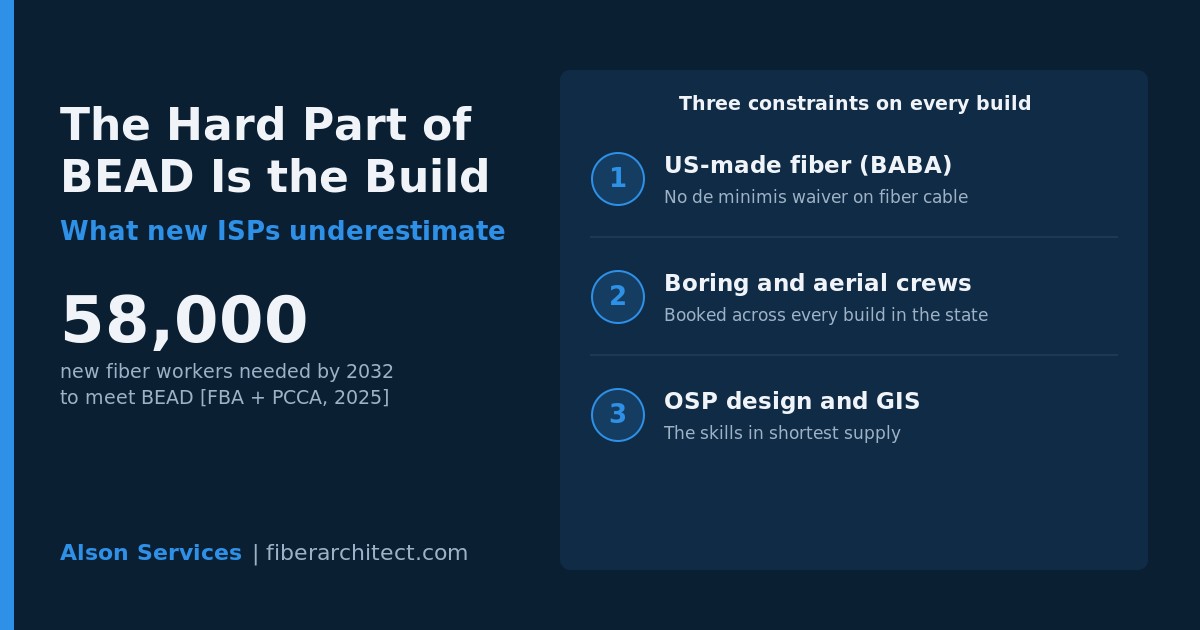
The fiber sector needs at least 58,000 new workers by 2032 to meet demand from BEAD and related programs, 28,000 of them in construction and 30,000 in technician roles [FBA and PCCA, 2025]. A first-time ISP that just won an award is now competing for those same crews.
BEAD construction is ramping across dozens of states at once through 2026 and 2027, and new entrants without in-house engineering or established crews face the same constrained market as incumbents. Near-term demand centers on OSP engineers and GIS specialists, with splicers and bore operators peaking soon after [Pew, 2025]. For a new ISP, the award is the easy part. Turning it into a built network is where the gaps show.
Start with materials. BEAD requires fiber optic cable to be manufactured entirely in the United States, and the de minimis waiver that covers small miscellaneous purchases does not apply to optical fiber or fiber cable [NTIA, 2025]. That means longer lead times, documented supply chains, and no shortcuts on the single most important material on the job. A sourcing plan that assumed off-the-shelf availability will slip the schedule.
Then labor. Underground construction runs a median of $18.25 per foot, and labor is 60 to 80 percent of that cost [FBA and Cartesian, 2024]. Crews for directional boring and aerial pulls are booked against every other BEAD build in the state, so a new entrant without contractor relationships pays more and waits longer for the same footage.
The engineering is the part new ISPs underestimate most. High-level design, route engineering, splice plans, and as-built documentation are not optional paperwork. They keep a build inspectable, fundable, and predictable in cost. The workers in shortest supply right now are exactly the OSP engineers and GIS specialists a first-time applicant does not have on staff [Pew, 2025].
Alson builds custom agents in-house and brings the OSP engineering a new ISP does not carry on staff, so a first-time applicant can turn an award into design-ready plans without standing up an engineering team from scratch.
For a new ISP, the practical move is to lock engineering and material sourcing before the schedule, not after. Line up compliant fiber and design capacity early, because the crews and the OSP engineers, not the funding, decide whether you finish on time.
The awards are decided. The builds that finish will be the ones that solved the engineering and the supply chain before breaking ground.
Sources
- Pew Charitable Trusts, Demand for Broadband Workforce to Meet BEAD, 2025
- NTIA, Build America Buy America (BABA) Compliance and Reporting Requirements, 2025
- Fiber Broadband Association / Cartesian, Fiber Deployment Cost Annual Report 2024
- Fiber Broadband Association and PCCA workforce estimate (via Pew), 2025