A 50,000-passing market modeled at $847 per pass came back at $1,180 once construction started. The route didn't change. The parcel count did.
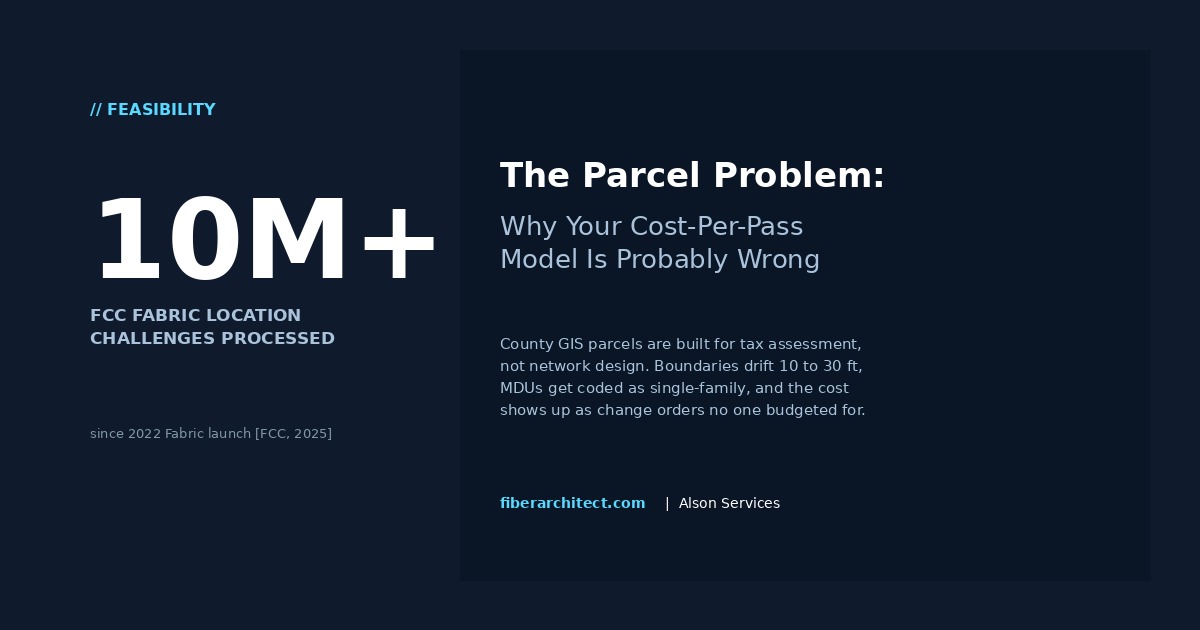
County parcel layers and the FCC's Broadband Serviceable Location Fabric (BSLF) drive almost every number on a feasibility model: passings, density, drop counts, BEAD eligibility, and ultimately cost per pass. When those layers are wrong, every downstream number is wrong with them. The FCC's Broadband Data Collection has processed more than 10 million location challenges since the Fabric launched, most tied to missing or misclassified serviceable locations [FCC, 2025].
County GIS parcels are built for tax assessment, not network design. Boundary lines are routinely off by 10 to 30 feet, easement data is missing or incomplete, and new construction can lag permitting by 12 to 24 months before it appears in the assessor's layer. For aerial design that gap is tolerable. For underground bores, drop placement, and HDD planning, it multiplies labor hours quickly and shows up as change orders no one budgeted for.
Address points are worse. A single parcel may carry one address point but contain a fourplex, an ADU, or a converted garage unit. Vacant lots get coded as buildable. MDUs get coded as single-family. The BSLF, maintained by CostQuest Associates, normalizes some of this but still inherits assessor-grade error at the source [CostQuest Fabric Methods Manual, 2023]. The Fabric's challenge process is the correction mechanism, not a substitute for verification.
For BEAD, the cost is concrete. The NTIA NOFO requires bids modeled against Fabric locations [NTIA BEAD NOFO, 2022]. If your passings count is 8% high, your bid per location is 8% low, and you either absorb the delta or walk away from the award.
Alson's cost-per-pass feasibility models normalize county parcels against the BSLF, current building footprint imagery, and address validation before any route is drawn. The 48-hour turnaround is only useful if the inputs are clean.
Before you accept any feasibility number, ask which data layer drove the passings count, when it was last updated, and whether MDUs and ADUs were resolved against imagery. A model built on stale assessor data isn't a model. It's a guess wrapped in a spreadsheet.
Routes are the easy part. Counting what's actually there is the work.
Sources
- FCC Broadband Data Collection Update, May 2025 — figure for more than 10 million location challenges processed since 2022.
- FCC Broadband Data Collection Resources — program overview, data downloads, and challenge-process documentation.
- CostQuest BSLF Methods Manual (June 2023) — source-data inputs and known limitations of the Fabric build.
- NTIA BEAD Program Notice of Funding Opportunity — program rules, including location-level bidding against the Fabric.